Here's a breakdown:
* Geocentric model: This model, popularized by Aristotle, placed the Earth at the center of the universe, with the Sun, Moon, and planets orbiting it.
* Observed irregularities: Planets don't simply move in perfect circles around the Earth. They exhibit retrograde motion (appearing to move backwards in their orbits), varying speeds, and changes in brightness.
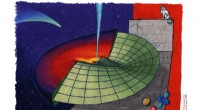
* Epicycles and deferents: To reconcile these observations with the geocentric model, astronomers developed a complex system of circles within circles.
* Deferents: Planets were assumed to orbit the Earth on large circles called deferents.
* Epicycles: Each planet was further assumed to orbit a smaller circle called an epicycle, whose center was moving along the deferent.
This intricate system of circles allowed astronomers to create mathematical models that could predict the positions of planets with reasonable accuracy, even though they weren't based on the true nature of the solar system.
However, the use of epicycles and deferents had a significant drawback:
* Increasing complexity: The system became increasingly convoluted as more planets were discovered and their motions were studied in greater detail. This complexity led to a growing sense of dissatisfaction among some astronomers, who felt it was too artificial and lacked a true physical explanation.
Ultimately, the geocentric model and its reliance on epicycles and deferents was replaced by the heliocentric model proposed by Nicolaus Copernicus, which placed the Sun at the center of the solar system and provided a simpler and more accurate explanation for the observed planetary motions.