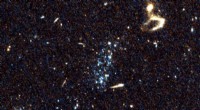
* They are faint: Red dwarfs are much smaller and cooler than our Sun, making them very dim. They are often too faint to be seen with the naked eye.
* They are numerous: Red dwarfs are the most common type of star in our galaxy. There are billions of them, making it impractical to give them individual names.
Instead of names, red dwarfs are typically identified by their catalog numbers:
* Gliese Catalog (GJ): This catalog lists nearby stars, including many red dwarfs.
* 2MASS (Two Micron All-Sky Survey): This catalog identifies infrared sources, including many red dwarfs.
* Other catalogs: There are numerous other astronomical catalogs that list red dwarfs, often using designations like "HD" (Henry Draper Catalogue) or "TIC" (Transiting Exoplanet Survey Satellite).
Examples of red dwarfs with their catalog numbers:
* Proxima Centauri (GJ 629 A): The closest star to our Sun.
* Barnard's Star (GJ 699): The second-closest star to our Sun.
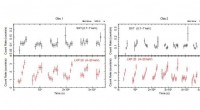
* TRAPPIST-1 (2MASS J23062928+0502285): A red dwarf with several Earth-sized planets.
So, while red dwarfs don't have common names like Sirius or Vega, they are still fascinating objects that are actively studied by astronomers.