* Scintillation is an atmospheric phenomenon: Twinkling is caused by the Earth's atmosphere. As starlight passes through different layers of air with varying densities, it gets bent and refracted. This bending changes the direction of the light reaching our eyes, making the star appear to flicker or twinkle.
* Hubble Telescope is in space: The Hubble Telescope orbits above Earth's atmosphere. This means it observes stars and other celestial objects without the distortion caused by atmospheric turbulence. Therefore, the stars viewed through the Hubble Telescope do not twinkle.
How the Hubble Telescope benefits from being above the atmosphere:
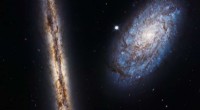
* Sharper images: Hubble's images are incredibly detailed and clear because it avoids the blurring effect of Earth's atmosphere.
* Wider range of wavelengths: Hubble can observe light in a wider spectrum of wavelengths, including ultraviolet and infrared light, which are blocked by the atmosphere.
* Unobstructed view: Hubble has an uninterrupted view of the cosmos, allowing for continuous observation of celestial events.
So, while the twinkling of stars is a common sight from Earth, it's a phenomenon the Hubble Telescope doesn't experience due to its location in space.