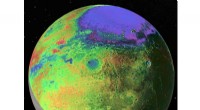
Mars' surface is a diverse landscape, largely composed of:
Minerals:
* Basalt: A dark, volcanic rock, similar to what makes up Earth's ocean floor. It's common in the northern lowlands.
* Andesite: A lighter-colored volcanic rock, found in some volcanic regions.
* Feldspar: A common mineral found in both basalt and andesite.
* Iron Oxides: These give Mars its signature reddish color, and are responsible for the formation of minerals like hematite and goethite.
* Clay minerals: Found in some areas, indicating past water activity.
* Carbonates: Found in some areas, also indicating past water activity.
* Silica: Found in some areas, suggesting past volcanic activity or hydrothermal systems.
Other Components:
* Dust: Fine-grained particles, composed mainly of iron oxides and silica. Dust storms can cover the entire planet.
* Rocks: A wide variety of rocks are found on Mars, including sedimentary rocks, igneous rocks, and metamorphic rocks.
* Ice: Water ice is found beneath the surface, and even on the surface at the poles and in craters.
* Frozen Carbon Dioxide (dry ice): Found at the poles, particularly during winter.
Notable Features:
* Valles Marineris: A massive canyon system, evidence of tectonic activity and erosion.
* Olympus Mons: The largest volcano in the solar system, formed by volcanic eruptions.
* Tharsis Bulge: A huge volcanic plateau, indicating significant volcanic activity in the past.
* Polar ice caps: Composed of both water ice and frozen carbon dioxide.
Evidence of Past Water:
* Dry riverbeds: Channels that appear to have been carved by flowing water.
* Delta deposits: Evidence of ancient lakes and river systems.
* Mineral deposits: Clay minerals and carbonates indicate the presence of liquid water in the past.
The composition of the Martian surface is still being studied, and new discoveries are constantly being made. This diverse landscape holds valuable clues to the history of Mars and its potential for past and future life.