The Giant Impact Hypothesis
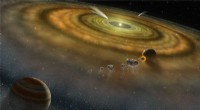
1. Early Solar System: In the early solar system, about 4.5 billion years ago, the Earth was still forming and was surrounded by a disk of gas and dust.
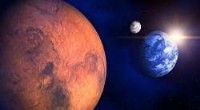
2. The Impact: A Mars-sized object, often called Theia, collided with the young Earth at a glancing blow. The impact was catastrophic, vaporizing much of Theia and blasting material from Earth's crust and mantle into space.
3. The Moon Forms: The ejected material, along with debris from Theia, coalesced in orbit around Earth, eventually forming the Moon.
Evidence Supporting the Hypothesis:
* Composition: The Moon's composition is remarkably similar to Earth's mantle, suggesting it originated from Earth. However, it also has trace elements that are not found in Earth's crust, which could be from Theia.
* Orbit: The Moon's orbital plane is tilted slightly compared to Earth's equator, which is consistent with a glancing impact.
* Angular Momentum: The Earth-Moon system has a large angular momentum, which is difficult to explain without a large impact.
* Lunar Samples: Analysis of lunar samples from Apollo missions has revealed isotopic signatures that further support the idea of a giant impact.
Alternative Theories (Less Supported):
* Capture Hypothesis: This theory proposes that the Moon formed elsewhere and was later captured by Earth's gravity. However, it is difficult to explain how a large body could be captured in such a way.
* Co-formation Hypothesis: This theory suggests the Moon and Earth formed simultaneously from the same disk of material. This is less likely because the Moon has a different composition than Earth.
Ongoing Research:
While the Giant Impact Hypothesis is widely accepted, there are still some unanswered questions. Scientists continue to study lunar samples, analyze gravitational data, and model simulations to gain a better understanding of the Moon's formation and its implications for the evolution of Earth and life.