1. Hertzsprung-Russell Diagram (HR Diagram):
* Concept: The HR diagram plots stars based on their luminosity (brightness) and temperature (spectral type). Stars evolve along specific paths on this diagram as they age.
* How it works: By comparing a star's position on the HR diagram to theoretical evolutionary tracks, scientists can estimate its age.
* Limitations: This method works best for stars on the main sequence (the stage where they fuse hydrogen into helium). It's less reliable for evolved stars like red giants or white dwarfs.
2. Stellar Rotation:
* Concept: Young stars typically rotate faster than older stars due to angular momentum conservation.
* How it works: By measuring a star's rotational speed, scientists can estimate its age.
* Limitations: Rotation rates can be influenced by factors other than age, like magnetic fields and stellar activity.
3. Lithium Abundance:
* Concept: Lithium is a light element that is easily destroyed in stars during fusion. Older stars have less lithium than younger ones.
* How it works: Measuring the lithium abundance in a star's atmosphere provides a clue to its age.
* Limitations: Lithium depletion can be affected by other factors like convection and magnetic fields.
4. Chemical Composition:
* Concept: The chemical composition of a star changes over time as it fuses elements.
* How it works: Scientists analyze the abundance of specific elements (e.g., iron, magnesium, calcium) in a star's spectrum to estimate its age.
* Limitations: Requires precise measurements and accurate models of stellar evolution.
5. Binary Star Systems:
* Concept: In a binary system, two stars orbit each other. Their orbital period and separation provide information about their masses.
* How it works: By comparing the observed masses to theoretical models, scientists can estimate the age of the system.
* Limitations: Requires accurate measurements of the stars' orbits and masses.
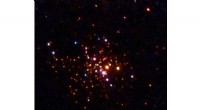
6. Star Clusters:
* Concept: Stars in a cluster are born at roughly the same time.
* How it works: By studying the distribution of stars of different ages in a cluster, scientists can estimate the age of the entire cluster, which is also the age of the individual stars.
* Limitations: Not all stars are born in clusters.
In summary:
* For main-sequence stars: HR diagram and lithium abundance are the most common methods.
* For evolved stars: Chemical composition and binary star systems are more useful.
* Star clusters: Provide valuable information about age, but not applicable to all stars.
Estimating a star's age is a complex process, and often multiple methods are used in combination to achieve the most accurate results.