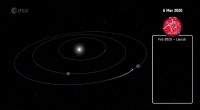
Orbital Period: The time it takes a planet to complete one full orbit around the Sun.
Semimajor Axis: The average distance between a planet and the Sun. This is often used as a simplified measure of a planet's orbital distance.
Orbital Eccentricity: A measure of how much a planet's orbit deviates from a perfect circle. A value of 0 indicates a perfectly circular orbit, while higher values represent more elliptical orbits.
Planet | Orbital Period | Semimajor Axis (AU) | Orbital Eccentricity
---|---|---|---
Mercury | 88 days | 0.39 AU | 0.206
Venus | 225 days | 0.72 AU | 0.007
Earth | 365.25 days | 1.00 AU | 0.017
Mars | 687 days | 1.52 AU | 0.093
Jupiter | 11.86 years | 5.20 AU | 0.048
Saturn | 29.46 years | 9.58 AU | 0.056
Uranus | 84.01 years | 19.22 AU | 0.046
Neptune | 164.79 years | 30.06 AU | 0.009
Important Notes:
* AU: Astronomical Unit - This is the average distance between the Earth and the Sun.
* Orbital Shape: While most planets have slightly elliptical orbits, the eccentricities are relatively low, meaning their orbits are close to circular.
* Orbital Inclination: Each planet also has an orbital inclination, which is the angle between its orbital plane and the plane of Earth's orbit (the ecliptic). These inclinations are generally small.
Additional Information:
* Orbital Speed: Planets move faster when closer to the Sun and slower when farther away.
* Gravitational Influence: The Sun's gravity is the primary force that keeps planets in their orbits.
* Orbital Perturbations: The gravitational pull of other planets can slightly affect a planet's orbit over long periods.
Let me know if you'd like more details about any specific aspect of planetary orbits!