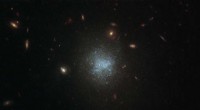
* Small Size: Dwarf galaxies are much smaller than larger spiral or elliptical galaxies like our own Milky Way. They contain far fewer stars, often only a few million to a few billion, compared to the Milky Way's hundreds of billions.
* Low Dust Content: Dwarf spheroidal galaxies are known for having very little dust and gas. This is partly due to their lower overall mass, meaning they have weaker gravity to hold onto interstellar material.
* Older Stars: The stars in dwarf spheroidal galaxies are generally older and redder than those in larger galaxies. This is because they haven't had much recent star formation due to their lack of gas and dust.
Examples of dwarf spheroidal galaxies:
* Sagittarius Dwarf Spheroidal Galaxy: One of the Milky Way's closest satellite galaxies, it's about 1/100th the mass of our own galaxy.
* Ursa Minor Dwarf Galaxy: Another Milky Way satellite galaxy, it's even smaller than the Sagittarius dwarf.
Important Note: While dwarf spheroidal galaxies are often described as having "very little" dust, it's important to remember that they still contain some. It's just far less than what is found in larger galaxies.
Let me know if you'd like to know more about dwarf galaxies or specific examples!