1. Elemental Composition:
* Heavy Elements: The Sun's composition is primarily hydrogen and helium, but it contains a small percentage of heavier elements like carbon, oxygen, iron, and silicon. These heavier elements are not readily formed in the early universe and are believed to be synthesized in the cores of stars during their life cycle and released into space during supernova explosions.
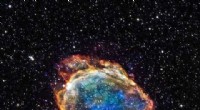
* Abundance Ratios: The specific ratios of these heavy elements in the Sun match closely with the ratios found in the remnants of supernovae, further supporting the idea that these elements originated in a previous star.
2. Stellar Evolution and Supernovae:
* Supernovae as Factories: Supernovae are powerful explosions that occur when massive stars reach the end of their lives. These events create and disperse heavy elements, enriching the interstellar medium.
* Interstellar Clouds: The Sun formed within a giant molecular cloud, a cold, dense region of gas and dust in the Milky Way galaxy. These clouds are enriched with heavy elements from previous supernovae.
3. Radioactive Isotopes:
* Short-Lived Isotopes: The Sun contains traces of short-lived radioactive isotopes, like aluminum-26, which have a relatively short half-life. These isotopes cannot be created in the Sun itself. Instead, they are believed to have originated in a supernova that occurred shortly before the Sun's formation, indicating that the Sun formed from the remnants of that supernova.
4. Galactic Disk Composition:
* Metallicity Gradient: The Milky Way galaxy has a metallicity gradient, with stars in the outer disk containing fewer heavy elements than those in the inner disk. This is consistent with the idea that stars in the outer disk formed from less enriched material, while those in the inner disk formed from material enriched by multiple generations of supernovae.
5. Solar System Objects:
* Meteorites: Meteorites contain traces of isotopes and elements that point to their origin in the interstellar medium, indicating that the material from which they formed was enriched by previous supernovae.
6. Theoretical Models:
* Stellar Evolution Models: These models predict that stars with masses similar to the Sun form from material enriched by supernovae.
* Cosmological Models: The Big Bang theory and subsequent stellar evolution processes suggest that the Sun could not have formed directly from the primordial hydrogen and helium of the early universe.
While we cannot directly observe the supernova that created the material for the Sun, the evidence points strongly to the idea that it was formed from the remnants of a previous star, enriching the interstellar medium and providing the building blocks for our solar system.