* Different parts of the Milky Way rotate at different speeds. The Milky Way is a spiral galaxy, and its rotation isn't uniform.
* The inner parts (near the galactic center) rotate faster.
* The outer parts (where our Sun is located) rotate slower.
* The Milky Way itself doesn't have a single rotation speed. It's more accurate to talk about the speed of specific objects within the galaxy.
Here's a breakdown of some key speeds:
* Our Sun: It takes about 225-250 million years for the Sun to complete one orbit around the galactic center. That translates to a speed of approximately 220 kilometers per second (137 miles per second).
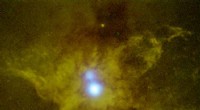
* Galactic Center: The material directly around the supermassive black hole at the galactic center rotates much faster, at speeds of hundreds of kilometers per second.
* Outer regions: The outer parts of the Milky Way rotate slower, likely at speeds less than 100 kilometers per second.
Important Considerations:
* Spiral arms: While the overall rotation of the Milky Way is in a disc-like shape, its spiral arms are not rigidly attached and move more like waves.
* Dark matter: The Milky Way's rotation is influenced by the presence of dark matter, a mysterious substance that we can't see directly but that makes up a significant portion of the galaxy's mass.
So, while there's no single "speed" for the Milky Way, we can describe the speeds of its individual components, which vary significantly depending on their location within the galaxy.