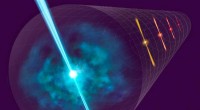
1. Gravitational Collapse:
- Within a nebula, tiny variations in density cause some regions to have slightly more mass than others.
- These denser regions exert a stronger gravitational pull, attracting surrounding gas and dust.
- As more material is pulled in, the region becomes even denser and its gravity increases, leading to a runaway collapse.
2. Protostar Formation:
- As the collapsing cloud spins and compresses, the core heats up due to friction and collisions between particles.
- When the core temperature reaches millions of degrees Celsius, it becomes a protostar – a hot, dense, and luminous object that still isn't a true star.
3. Nuclear Fusion Ignition:
- The protostar continues to accrete material and its core grows hotter and denser.
- Eventually, the core reaches a critical temperature and pressure where nuclear fusion ignites.
- In this process, hydrogen atoms fuse to form helium, releasing immense amounts of energy.
- This energy output creates outward pressure that balances the inward force of gravity, preventing further collapse.
4. Main Sequence Star:
- The protostar has now become a true star, entering the main sequence stage of its life.
- It will spend the majority of its lifetime fusing hydrogen into helium in its core, generating energy and emitting light and heat.
- The star's size, temperature, and luminosity depend on its initial mass.
5. Beyond the Main Sequence:
- After billions of years, the star will run out of hydrogen fuel in its core.
- It will then evolve through various stages depending on its initial mass, potentially becoming a red giant, a white dwarf, a supernova, or a black hole.
Key Points:
* Star formation is a continuous process happening throughout the universe.
* The birth of a star is triggered by gravitational collapse within nebulae.
* Nuclear fusion is the key process that powers a star.
* The properties of a star are determined by its initial mass.
Additional Information:
* The process of star birth is complex and involves various physical phenomena like accretion, radiation pressure, and magnetic fields.
* The study of star formation helps us understand the origins of stars, planets, and galaxies.
* Scientists use telescopes and computer simulations to observe and model star birth.