1. Light as a Wave: Light behaves like a wave, and just like sound waves, the frequency of light waves can change depending on the relative motion between the source and the observer.
2. Redshift and Blueshift:
* Redshift: If a star is moving away from Earth, the light waves it emits are stretched out, making the light appear redder (lower frequency). This is called redshift.
* Blueshift: If a star is moving towards Earth, the light waves are compressed, making the light appear bluer (higher frequency). This is called blueshift.
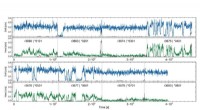
3. Measuring the Shift: Astronomers use spectrometers to analyze the light coming from stars. They look for specific spectral lines, which are unique to each element present in the star. By measuring the shift in these lines (whether they are redder or bluer than expected), astronomers can determine if the star is moving towards or away from Earth.
4. Calculating Velocity: The amount of redshift or blueshift is directly related to the star's velocity relative to Earth. A larger shift indicates a faster speed.
In Summary: By analyzing the redshift or blueshift of a star's light, astronomers can determine its radial velocity – the speed at which it is moving towards or away from us. This information is crucial for understanding the motion and evolution of stars and galaxies.