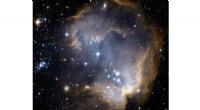
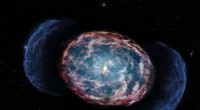
* Interstellar gas and dust: This is a very thin, but vast, collection of gas (primarily hydrogen and helium) and dust particles. It's not evenly distributed, but forms clouds and filaments that can stretch for light-years.
* Cosmic rays: These are high-energy particles, mostly protons and atomic nuclei, that travel at near-light speed. They originate from various sources, including supernovae and active galactic nuclei.
* Magnetic fields: Galaxies have their own magnetic fields, and individual stars and planets also generate their own fields. These fields interact and influence the movement of charged particles, like cosmic rays.
* Dark matter: While we can't see it directly, evidence suggests that dark matter comprises a large portion of the universe. Its gravitational influence helps explain the rotation of galaxies and other cosmological phenomena.
* Electromagnetic radiation: Light and other forms of electromagnetic radiation travel through space. This includes visible light from stars, infrared radiation from dust clouds, and radio waves emitted by pulsars.
* Neutrinos: These are subatomic particles that interact very weakly with matter. They are produced in nuclear reactions, like those occurring in the sun.
* Gravitational waves: These ripples in spacetime are created by massive objects accelerating, such as colliding black holes or merging neutron stars.
So, while it might seem like empty space, the region between planets and stars is actually filled with a surprising amount of matter, energy, and even mysteries that we are still trying to understand.