Stars:
* Formation: Gravity pulls together clouds of gas and dust, causing them to collapse and heat up, eventually leading to nuclear fusion and the birth of a star.
* Stability: Gravity balances the outward pressure from nuclear fusion in a star's core, keeping it stable.
* Evolution: As stars age, gravity influences their evolution. Gravity causes them to collapse, potentially leading to supernova explosions or the formation of white dwarfs, neutron stars, or black holes.
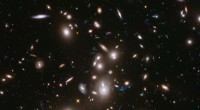
* Stellar systems: Gravity holds together stars in binary systems and larger clusters of stars called galaxies.
Moons:
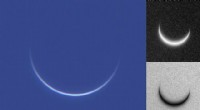
* Orbit: Gravity keeps moons in orbit around their planets. The moon's orbital path is determined by the gravitational pull of the planet and the moon's own velocity.
* Tidal forces: Gravity creates tidal forces on moons. These forces are caused by the difference in gravitational pull between the side of the moon facing the planet and the side facing away. This difference in pull can cause tides, stretching and deforming the moon.
* Synchronization: In some cases, gravity can cause moons to become tidally locked to their planets. This means that the same side of the moon always faces the planet. An example is our moon, which is tidally locked to Earth.
Planets:
* Orbit: Gravity keeps planets in orbit around their stars. The orbital path of a planet is determined by the gravitational pull of the star and the planet's own velocity.
* Rotation: Gravity influences a planet's rotation rate. This is often affected by the gravitational pull of other planets or moons in the system.
* Shape: Gravity also plays a role in a planet's shape. Planets are not perfectly spherical but are slightly flattened at their poles and bulge at their equators due to their rotation and the forces of gravity.
* Structure: Gravity helps shape a planet's internal structure. It compresses materials in the planet's core, affecting its density and composition.
Overall: Gravity is the invisible force that shapes the universe and orchestrates the dance of celestial objects. Its influence is evident in every aspect of a star, moon, and planet's existence.