1. Composition:
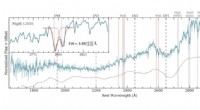
* What Elements Are Present? The presence of specific absorption lines indicates the presence of specific elements in the star's atmosphere. Each element absorbs light at unique wavelengths, creating a distinct "signature" in the spectrum.
* Abundance: The strength of the absorption lines tells us how much of each element is present. Stronger lines indicate a higher abundance of that element.
2. Temperature:
* Ionization Levels: The absorption lines of some elements appear differently depending on their ionization state (whether they have lost or gained electrons). By analyzing the ionization state of elements in a star's spectrum, we can determine its temperature.
* Spectral Classes: Stars are classified into spectral classes (O, B, A, F, G, K, M) based on their temperature. The absorption lines present in each class provide a strong indication of the star's temperature.
3. Pressure:
* Line Broadening: The absorption lines can be broadened due to the pressure of the star's atmosphere. This broadening is caused by collisions between atoms, which slightly shift the wavelengths of light they absorb.
* Line Strength: The strength of absorption lines can also be affected by pressure. In general, higher pressure leads to weaker lines.
4. Motion:
* Doppler Shift: The absorption lines can be shifted slightly due to the star's motion relative to us. If the star is moving towards us, the lines are shifted towards the blue end of the spectrum (blueshift), and if it's moving away, the lines are shifted towards the red end (redshift). This phenomenon, known as the Doppler effect, allows us to measure the star's radial velocity (motion towards or away from us).
5. Other Information:
* Magnetic Fields: Some absorption lines are split into multiple components due to the star's magnetic field. This phenomenon, known as the Zeeman effect, allows us to study the strength and direction of the magnetic field.
* Rotation: The width of absorption lines can also be affected by the star's rotation. Faster rotation causes a broader line profile.
In summary, absorption lines provide a powerful tool for understanding the physical properties of stars, allowing us to glimpse into their composition, temperature, pressure, motion, and even magnetic fields.