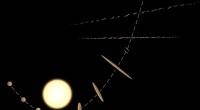
1. Orbital Period (P): This is the time it takes for the two stars to complete one full orbit around their common center of mass. You can determine this by observing the timing of the eclipses.
2. Orbital Separation (a): This is the distance between the two stars. It's difficult to directly measure the separation, but you can calculate it using the following:
* The duration of the eclipses: The longer the eclipse, the larger the star involved.
* The light curve of the system: Analyzing the changes in brightness during the eclipses can help you determine the relative sizes of the stars.
How to use this information:
Once you know the orbital period (P) and the orbital separation (a), you can use Kepler's Third Law of Planetary Motion to calculate the combined mass of the system (M1 + M2):
```
P^2 = (4π^2/G(M1+M2)) * a^3
```
Where:
* P is the orbital period
* G is the gravitational constant
* M1 and M2 are the masses of the two stars
* a is the orbital separation
To get the individual masses of the stars (M1 and M2), you need one more piece of information, which is the radial velocity of each star. This can be determined by observing the Doppler shift in the star's spectral lines.
Let me know if you'd like to explore this further!