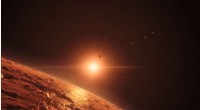
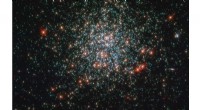
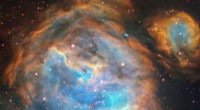
* Luminous: Stars emit light and heat, primarily through nuclear fusion reactions occurring in their cores.
* Sphere of plasma: Stars are not solid objects, but rather giant balls of superheated gas (plasma) consisting primarily of hydrogen and helium.
* Held together by its own gravity: The immense gravitational pull of a star's mass keeps the plasma from dispersing into space.
Key characteristics of a star:
* Nuclear Fusion: Stars generate energy through nuclear fusion, where hydrogen atoms fuse to form helium, releasing vast amounts of energy.
* Self-sustaining: The energy produced by fusion creates outward pressure that balances the inward gravitational pull, maintaining the star's stability for millions or billions of years.
* Spectral Classification: Stars are categorized by their surface temperature and spectral characteristics (e.g., O, B, A, F, G, K, M). Our Sun is a G-type star.
* Lifecycles: Stars have finite lifespans, evolving through stages depending on their mass, eventually reaching a final stage like a white dwarf, neutron star, or black hole.
It's important to note that:
* Not every luminous object in the universe is a star. Objects like planets, moons, and even some nebulae can also emit light, but they don't produce their own light through nuclear fusion.
* There are other astronomical objects, such as brown dwarfs, which don't quite meet the definition of a star because they lack the mass to sustain nuclear fusion.
In essence, stars are the fundamental building blocks of galaxies, and their existence is what allows for the formation of planets and the possibility of life as we know it.