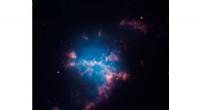
* Extreme Density: Neutron stars are incredibly dense, packing the mass of a star like our Sun into a sphere only about 20 kilometers across. This means the matter is squeezed together with tremendous force.
* Strong Gravitational Pull: The intense density results in an immense gravitational pull. The surface gravity of a neutron star can be hundreds of billions of times stronger than Earth's gravity.
Estimating Gravity:
There's no single answer to "what is the gravity on a neutron star" because it varies depending on:
* Mass: More massive neutron stars have stronger gravity.
* Radius: Smaller radius neutron stars have stronger gravity (for the same mass).
To give you an idea:
* The surface gravity of a typical neutron star is roughly 2 x 10^11 times stronger than Earth's gravity. This means if you weighed 100 pounds on Earth, you'd weigh 20 billion pounds on a neutron star!
* This extreme gravity warps spacetime, creating a very strong gravitational field.
Consequences of Strong Gravity:
* Light Bending: The immense gravity of a neutron star bends light, causing it to travel in curved paths. This can create the effect of "gravitational lensing".
* Time Dilation: Time slows down near a neutron star due to its strong gravitational field. This is known as gravitational time dilation.
* Tidal Forces: The difference in gravitational pull between the near and far sides of an object can cause extreme tidal forces, capable of tearing apart even large objects.
In Summary:
The gravity on a neutron star is incredibly strong, making them some of the densest and most extreme objects in the universe.