1. Spectroscopy:
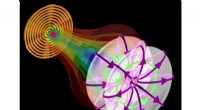
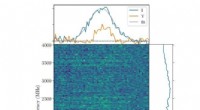
* Light Analysis: Stars emit light across a wide range of wavelengths, forming their unique spectra. This is similar to how a prism separates white light into a rainbow.
* Absorption Lines: When light passes through a star's atmosphere, specific elements absorb certain wavelengths, leaving dark lines (absorption lines) in the spectrum.
* Emission Lines: Hot gases in the star's atmosphere also emit light at specific wavelengths, creating bright lines (emission lines) in the spectrum.
2. Mathematical Models:
* Spectral Analysis: Scientists use mathematical models to analyze the patterns of absorption and emission lines in a star's spectrum.
* Elemental Identification: Each element has a unique set of spectral lines, allowing scientists to identify the elements present in the star's atmosphere.
* Abundance Determination: The strength of the absorption and emission lines indicates the relative abundance of each element in the star.
Key Techniques and Instruments:
* Telescopes: Large telescopes collect the light from distant stars.
* Spectrographs: These instruments separate the starlight into its component wavelengths, creating a spectrum.
* Computer Analysis: Powerful computers process the data and analyze the spectral lines.
Example:
If a star's spectrum shows strong absorption lines corresponding to hydrogen, helium, and a few trace elements like oxygen and carbon, it tells us that the star is primarily composed of hydrogen and helium, with small amounts of heavier elements.
Limitations:
* Distance: The further away a star is, the fainter its light, making it harder to analyze.
* Interstellar Dust: Dust in interstellar space can absorb and scatter starlight, affecting the observed spectrum.
* Stellar Evolution: The composition of a star can change over its lifetime, making it difficult to study its initial composition.
Despite these limitations, spectroscopy is a powerful tool that allows scientists to understand the composition of stars, their evolution, and the formation of planets.