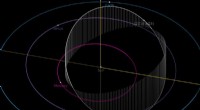
* The Oort Cloud: This vast region of icy objects extends far beyond Pluto. It's estimated to contain a significant amount of mass, but we don't have a precise measurement of it.
* Interstellar Dust and Gas: The solar system isn't a completely isolated entity. It interacts with the surrounding interstellar medium, exchanging matter.
* Dark Matter: While we don't have direct evidence of dark matter within our solar system, its existence is suggested by cosmological observations.
However, we can estimate the mass of the solar system based on what we know about its major components:
* The Sun: Accounts for about 99.86% of the total mass of the solar system. Its mass is approximately 1.989 × 10^30 kg.
* Planets: The eight planets (including Pluto) contribute a small fraction of the total mass.
* Moons, Asteroid Belt, Kuiper Belt: These add a tiny amount of mass compared to the Sun and planets.
Rough Estimate: The total mass of the solar system is likely to be slightly more than the Sun's mass, perhaps around 2 × 10^30 kg.
Keep in mind that this is a very rough estimate, and the actual mass could be higher or lower depending on factors we haven't fully accounted for.