1. Formation of Stars:
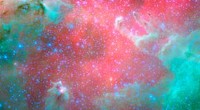
* Gravitational Collapse: Stars form from massive clouds of gas and dust. Gravity pulls these particles together, causing them to collapse under their own weight. As the cloud contracts, it heats up due to the conversion of gravitational potential energy into kinetic energy.
* Nuclear Fusion: When the core of the collapsing cloud reaches a high enough temperature and density, nuclear fusion begins. This process releases immense energy, creating the star's light and heat and counteracting the inward pull of gravity, establishing a stable equilibrium.
2. Formation of Planets:
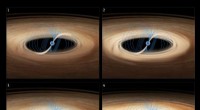
* Protoplanetary Disk: The leftover material around a newly formed star forms a rotating disk of gas and dust called a protoplanetary disk. Gravity continues to play a key role here.
* Planetesimal Formation: Small dust particles within the disk collide and stick together due to electrostatic forces. This process continues, forming larger and larger clumps called planetesimals.
* Planetary Accretion: Planetesimals grow by attracting more material through their own gravity. Eventually, they become large enough to sweep up most of the remaining material in their orbital path, forming planets.
3. Planetary Motions:
* Orbital Dynamics: Planets orbit stars due to the gravitational attraction between them. The gravitational force between a star and a planet is inversely proportional to the square of the distance between them. This means that the closer a planet is to its star, the stronger the gravitational pull and the faster its orbital speed.
* Kepler's Laws: The motions of planets are governed by Kepler's Laws of Planetary Motion, which are a direct result of the law of universal gravitation. These laws describe the elliptical paths of planets, the relationship between their orbital periods and distances, and the conservation of angular momentum.
4. Solar System Structure:
* Hierarchical Structure: Gravity establishes the hierarchical structure of solar systems. Stars hold the planets in orbit, planets hold their moons, and so on.
* Stability and Evolution: The gravitational interactions between planets influence their long-term stability and evolution. Resonances, where the orbital periods of planets are related in a simple ratio, can lead to stable or unstable configurations.
In Summary:
Gravity is the primary force responsible for the formation, structure, and motions of planets, stars, and solar systems. It drives the collapse of gas clouds to form stars, the accretion of planetesimals into planets, and the orbital dynamics that govern the movements of celestial bodies. Gravity is the invisible hand that shapes the cosmos, constantly influencing its evolution and creating the fascinating and complex universe we observe.