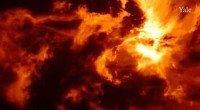
* Photosphere: This is the visible surface of the Sun. Here, we see:
* Sunspots: Darker areas on the photosphere caused by intense magnetic fields.
* Faculae: Bright regions associated with active regions.
* Granulation: A grainy appearance caused by convection cells.
* Chromosphere: This is the layer above the photosphere. Here, we see:
* Spicules: Small, jet-like eruptions of hot gas.
* Solar Flares: Powerful explosions releasing energy and particles.
* Prominences: Large loops of gas extending out from the chromosphere, often associated with sunspots.
* Corona: This is the outermost layer of the Sun's atmosphere. Here, we see:
* Coronal Mass Ejections (CMEs): Huge bursts of plasma and magnetic field that can travel out into space.
* Coronal Holes: Regions of lower density and temperature, where the solar wind streams out at higher speeds.
It's important to note that these disturbances are not fixed locations. They can appear in various places on the Sun's surface and evolve over time. The activity of the Sun varies in an 11-year cycle, with periods of higher activity and periods of lower activity. During periods of high activity, there are more sunspots, solar flares, and CMEs.