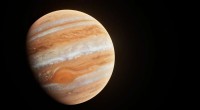
1. Dust and Gas Cloud: Jupiter started as a collection of dust and gas in the protoplanetary disk surrounding the young Sun. This disk was made up of hydrogen, helium, and heavier elements.
2. Gravitational Attraction: Over time, small particles within the disk began to clump together due to their mutual gravitational attraction. These clumps grew larger and larger, attracting more and more material.
3. Planetesimal Formation: Eventually, these clumps became large enough to be called planetesimals, small bodies that are the building blocks of planets.
4. Runaway Accretion: As planetesimals grew, their gravitational pull increased, allowing them to attract material from farther distances. This created a kind of "runaway" accretion, where Jupiter quickly gained a significant amount of mass.
5. Gas Giant Formation: Jupiter's immense gravitational pull allowed it to capture large amounts of hydrogen and helium gas, the most abundant elements in the early solar system. This is why Jupiter is classified as a gas giant, with a core of heavier elements surrounded by a massive atmosphere.
6. Clearing the Neighborhood: As Jupiter grew, its gravitational influence cleared the region around it of other smaller planetesimals, preventing the formation of another planet in its vicinity.
The entire process of Jupiter's formation took millions of years. While the basic steps are well understood, the exact details of how the core formed and how it captured so much gas are still areas of active research.