1. Formation in the Asteroid Belt:
* The theory proposes that the solar system formed from a rotating disk of gas and dust called the solar nebula.
* As the nebula collapsed, heavier elements (like iron and nickel) sank towards the center, while lighter elements (like rock and ice) were pushed outward.
* This process led to the formation of planets, with rocky planets forming closer to the sun and gas giants further out.
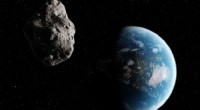
* The asteroid belt, located between Mars and Jupiter, marks the region where the transition from rocky to icy planets occurred. This location was too far from the sun for rocky planets to form, but too close for ice to condense efficiently.
* The asteroids represent the leftover material from this early period of planetary formation.
2. Gravitational Influence of Jupiter:
* Jupiter, the largest planet in our solar system, exerts a strong gravitational influence on its surroundings.
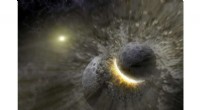
* This influence prevented the formation of a planet in the asteroid belt and instead led to the scattering and fragmentation of material in the region.
* The gravitational pull of Jupiter also explains the uneven distribution of asteroids within the belt.
3. Planetesimal Accretion:
* The theory suggests that planets formed through the gradual accretion of smaller bodies called planetesimals.
* Asteroids are essentially remnants of these planetesimals, which never fully coalesced into a larger planet due to Jupiter's influence.
4. Compositional Diversity:
* The solar nebula theory predicts a compositional gradient within the solar system, with denser, rocky materials closer to the sun and lighter, icy materials further out.
* This is reflected in the asteroid belt, with inner asteroids being primarily rocky and outer asteroids containing a higher proportion of ice and organic molecules.
In summary, the solar nebula theory explains the location of asteroids as a result of:
* The formation of the solar system with a distinct transition zone between rocky and icy planets.
* The strong gravitational influence of Jupiter preventing the formation of a planet in the asteroid belt.
* The survival of leftover planetesimals, which are now the asteroids we observe.
* The compositional gradient in the early solar nebula, reflected in the diverse composition of asteroids.