* Early Observations: While astronomers had observed Jupiter's four largest moons (including Io) since Galileo's time in the 17th century, they were just points of light through telescopes. There was no real knowledge of their composition, surface features, or activity.
* Spacecraft Flybys: The first major insights into Io came from the Pioneer 10 and 11 spacecraft in the early 1970s. These flybys showed Io to be a colorful, heavily cratered world, hinting at volcanic activity.
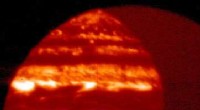
* The Game Changer: Voyager 1 and 2 (1979): These missions provided the first close-up images of Io, revealing its astounding volcanic activity. Active volcanoes were seen erupting, spewing plumes of sulfur and other materials into space, creating a thin atmosphere.
* Further Exploration: Subsequent missions like Galileo (1995-2003) and Juno (2016-present) have provided further details on Io's volcanoes, composition, and interactions with Jupiter's magnetic field.
So, it wasn't about "knowing" about Io, but rather progressively learning more and more about its unique characteristics through space exploration.
Today, thanks to the efforts of NASA and other space agencies, we have a much more detailed understanding of Io, making it one of the most fascinating and dynamic objects in our solar system.