Color:
* Temperature: The dominant color of a star's spectrum directly relates to its surface temperature.
* Blue stars: Hottest (over 25,000 Kelvin)
* White stars: Moderately hot (10,000-25,000 Kelvin)
* Yellow stars: Like our Sun, (5,000-10,000 Kelvin)
* Orange stars: Cooler (3,500-5,000 Kelvin)
* Red stars: Coolest (under 3,500 Kelvin)
Lines:
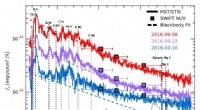
* Absorption Lines: Dark lines in a star's spectrum indicate specific wavelengths of light that are being absorbed by the star's atmosphere. These lines are like fingerprints, identifying the elements present in the star's atmosphere.
* Stronger lines: Indicate more of that element is present.
* Shifted lines: Can indicate the star's motion toward or away from us (redshift or blueshift, respectively) due to the Doppler effect.
* Emission Lines: Bright lines in a spectrum indicate specific wavelengths of light being emitted by the star.
* Stronger emission lines: Often indicate hotter regions, like the chromosphere of a star.
* Specific emission lines: Can indicate the presence of specific elements or processes occurring in the star's atmosphere, like ionization.
What can we learn from a star's spectrum?
* Composition: Identifying the elements present in a star's atmosphere.
* Temperature: Determining the star's surface temperature.
* Motion: Understanding if a star is moving toward or away from us.
* Luminosity: By comparing the observed brightness to the known spectral type, we can estimate the star's intrinsic luminosity.
* Age: Combining the information about temperature, luminosity, and composition, we can estimate the star's age.
* Evolutionary stage: Spectral analysis helps us understand where a star is in its life cycle.
In summary, a star's spectrum is like a detailed report card, revealing key information about its physical characteristics and evolutionary history.