1. Gravity:
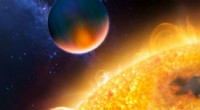
The most significant factor is the gravitational attraction between the planet and its star. This force pulls the planet towards the star, causing it to curve its path and follow an orbit. A perfectly circular orbit would occur if the planet's velocity was perfectly balanced with the star's gravitational pull.
2. Other celestial bodies:
While the star's gravity is dominant, the gravitational influence of other planets and objects within the star system can also affect the planet's orbit. This can lead to slight deviations from a perfect elliptical path, making the orbit more complex and potentially even chaotic over long periods.
Here's a breakdown of how these factors affect the shape of an orbit:
* Circular orbit: A perfect circular orbit is rare and requires very specific conditions where the planet's velocity is perfectly balanced with the star's gravitational pull.
* Elliptical orbit: Most planets in our solar system, including Earth, have elliptical orbits. This means their path around the star is not a perfect circle but rather an elongated oval.
* Perturbations: The gravitational pull of other planets in the system can cause "perturbations" in a planet's orbit. These are small deviations from the perfect elliptical shape that can add complexity to the orbit's path.
* Resonances: Sometimes the gravitational influence of other planets creates a "resonance" where the orbits of two planets have a mathematical relationship, leading to repeating patterns in their movements. This can also affect the shape of the orbit.
Important to note:
* The more massive the star, the stronger its gravitational pull, and the more likely the planet will have a more elliptical orbit.
* The closer the planet is to the star, the stronger the gravitational pull, and the more likely the orbit will be elliptical.
In conclusion: While gravity is the primary force shaping a planet's orbit, the gravitational interactions of other celestial bodies in the system contribute to its complexity and can make the orbit deviate from a simple elliptical shape.