Formation:
* Star Formation: Gravity is the driving force behind the creation of stars. Massive clouds of gas and dust in space, known as nebulae, are held together by their own gravity. As these clouds collapse under their own weight, they heat up and spin faster, eventually reaching a point where nuclear fusion ignites in the core, forming a star.
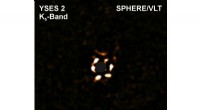
* Planet Formation: Gravity plays a crucial role in planet formation. Dust and gas particles in the protoplanetary disk surrounding a young star start to clump together due to gravitational attraction. These clumps grow larger, attracting more material, eventually forming planetesimals. Planetesimals further collide and merge under gravity, forming planets.
Maintenance:
* Holding Solar Systems Together: Gravity is the force that keeps planets in orbit around their star. It provides the centripetal force that balances the outward motion of the planets, preventing them from flying off into space.
* Maintaining Star Stability: Gravity within a star balances the outward pressure from nuclear fusion, preventing the star from collapsing under its own weight. This balance is crucial for the star's long-term stability and its ability to burn fuel at a steady rate.
* Tidal Forces: The gravitational pull of a planet on its moon, or a star on its planets, can cause tidal forces. These forces can cause stretching and deformation of objects, affecting their rotation and even leading to the creation of tides on planets with oceans.
* Formation of Moons: Gravity also plays a role in the formation of moons. Some moons are formed from the same disk of material that formed the planet, while others are captured objects that were pulled in by the planet's gravity.
Examples:
* The Sun: The Sun's immense gravity holds all the planets in our solar system in orbit.
* Jupiter: Jupiter's strong gravity helped to clear the inner solar system of debris, allowing the inner planets to form.
* The Earth-Moon System: The Moon's gravity is responsible for the Earth's tides.
In summary, gravity is the invisible force that shapes and maintains the structures of stars, planets, and solar systems. Without it, these celestial objects would not exist in the form we know them today.