Here's a simplified explanation:
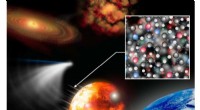
1. Hydrogen Fusion: In the core of a star, immense pressure and heat force hydrogen atoms (the simplest element) to fuse together. This process combines four hydrogen nuclei (protons) to form one helium nucleus, releasing a tremendous amount of energy in the process.
2. Energy Release: This fusion reaction releases energy in the form of light and heat, which is what makes stars shine and provides the outward pressure that balances the inward force of gravity.
3. Mass-Energy Equivalence: The key principle here is Einstein's famous equation E=mc², which states that energy (E) and mass (m) are equivalent and can be converted into each other. The mass of the helium nucleus is slightly less than the combined mass of the four hydrogen nuclei. This "missing" mass is converted into energy.
In summary, nuclear fusion in stars is a continuous process where hydrogen is converted into helium, releasing tremendous energy and powering the star's luminosity.