Here's a little more information about them:
* Formation: Sunspots are cooler regions on the Sun's surface (photosphere) caused by intense magnetic activity. The strong magnetic fields inhibit the flow of hot plasma, leading to a decrease in temperature.
* Appearance: Sunspots appear darker because they are about 1,000-1,500 degrees Celsius cooler than the surrounding photosphere. This makes them appear dark in contrast, but they still radiate significant amounts of energy.
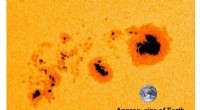
* Size and Shape: Sunspots range in size from small, barely visible spots to huge regions larger than the Earth. They often appear in pairs or groups, connected by magnetic loops.
* Solar Cycle: Sunspots are closely linked to the Sun's magnetic cycle, which has an average period of about 11 years. The number of sunspots observed on the Sun varies over this cycle, with a maximum number of sunspots occurring around the solar maximum and a minimum during the solar minimum.
* Impact: Sunspots can have a significant impact on Earth, influencing space weather phenomena like solar flares and coronal mass ejections (CMEs). These events can disrupt radio communications, damage satellites, and even cause power outages.
Let me know if you want to know more about any aspect of sunspots!