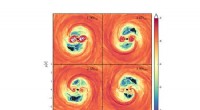
1. Nebulae: These clouds are primarily composed of hydrogen and helium, with traces of other elements. They are incredibly vast and cold, often spanning light-years in size.
2. Gravitational Collapse: Over time, gravity causes the particles within a nebula to clump together. As the density increases, the temperature and pressure within the core of the clump also rise.
3. Protostar Formation: Eventually, the core becomes so hot and dense that nuclear fusion begins. This is the point where the clump officially becomes a protostar.
4. Nuclear Fusion: In the core of a protostar, hydrogen atoms fuse together to form helium, releasing enormous amounts of energy. This energy creates outward pressure that balances the inward pull of gravity.
5. Main Sequence Star: The protostar stabilizes and becomes a main sequence star. This is the stage where the star spends most of its life, burning hydrogen and producing light and heat.
6. Evolution and Death: As a star ages, it begins to run out of hydrogen fuel. It will then evolve into a red giant, a white dwarf, or even a supernova depending on its mass.
So, in summary, stars are born from the gravitational collapse of nebulae, which are giant clouds of gas and dust. The process of nuclear fusion within the core of a star powers its light and heat.