1. The Nebula:
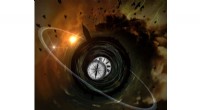
* Begins with a giant cloud of gas and dust. This cloud, called a nebula, is primarily composed of hydrogen and helium, with traces of heavier elements.
* Gravity starts to pull the particles together. As the cloud collapses, it spins faster due to conservation of angular momentum.
* The cloud heats up. As particles collide, they release energy in the form of heat.
2. Formation of the Protosun:
* The center of the collapsing cloud becomes denser and hotter. Eventually, the core reaches a temperature and pressure high enough for nuclear fusion to begin.
* Nuclear fusion ignites, forming the sun. The sun's powerful gravity continues to draw in surrounding material.
3. Formation of the Protoplanetary Disk:
* The spinning cloud flattens into a disk. This is caused by centrifugal force pushing material outward.
* The disk contains gas and dust particles. These particles start to clump together due to electrostatic forces and collisions.
* Planetesimals form. These are small, rocky or icy bodies that are the building blocks of planets.
4. Formation of Planets:
* Planetesimals continue to collide and grow. Larger planetesimals have more gravitational pull, attracting more particles.
* Planets accrete. Over millions of years, planetesimals merge into larger bodies, eventually forming the planets we know today.
* The remaining gas and dust is either swept away by solar winds or incorporated into the planets.
5. Differentiation and Evolution:
* Planetary differentiation occurs. Denser materials like iron and nickel sink to the core, while lighter elements rise to the surface.
* Planets evolve. Over time, planetary atmospheres are formed, geological processes shape surfaces, and moons may form around some planets.
This process is ongoing. Our solar system is still evolving and changing, though much more slowly than during its initial formation.
Key points:
* Gravity is the driving force behind the formation of planets.
* The process takes millions of years.
* The nebular theory is widely accepted by scientists.
* It explains the similarities and differences between the planets in our solar system.
This is a simplified explanation, and there are many more details involved in the nebular theory. However, it gives you a good understanding of the basic steps involved in the formation of our solar system.