* Red Giant Branch (RGB): This is the first major red giant phase. Stars on the RGB are fusing hydrogen in a shell around their core, which is now mostly composed of inert helium.
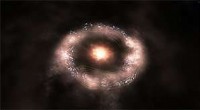
* Asymptotic Giant Branch (AGB): After the RGB, stars with intermediate masses (roughly 0.8 to 8 solar masses) enter the AGB. Here, they fuse helium in their core, producing carbon and oxygen. This phase is also characterized by strong pulsations and mass loss, leading to the formation of planetary nebulae.
* Horizontal Branch: For stars slightly less massive than those reaching the AGB, after the RGB they spend some time on the horizontal branch. This is a brief phase where they fuse helium in their core, but they are not considered red giants.
Key Points:
* Not stages, but branches: Stars don't go through two or more *stages* of red giant expansion. They go through different *branches* of stellar evolution, each with distinct characteristics.
* Mass matters: The specific evolutionary path a star takes depends on its initial mass. The more massive a star, the more complex its life cycle.
* Beyond red giants: Stars can also become supergiants in later stages, but these are not typically considered red giants.
So, while a star may indeed have multiple red giant phases, it's more accurate to describe them as distinct branches of stellar evolution.