1. Formation of the Nebula:
* The nebula, composed mostly of hydrogen and helium, was likely formed by the remnants of a supernova explosion.
* This cloud was vast, cold, and slowly rotating.
2. Gravitational Collapse:
* Over time, gravitational forces within the nebula caused it to contract.
* As the nebula contracted, its rotation speed increased due to the conservation of angular momentum.
* This rotation flattened the nebula into a spinning disk, with a dense, hot core at the center.
3. Formation of the Protostar:
* The core of the collapsing nebula became so dense and hot that nuclear fusion began, creating a protostar.
* The protostar continued to grow by accreting material from the surrounding disk.
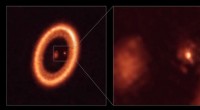
4. Formation of the Protoplanetary Disk:
* The rotating disk around the protostar contained dust and gas particles.
* These particles began to clump together due to electrostatic forces and collisions, forming planetesimals.
5. Formation of Planets:
* Planetesimals continued to collide and grow, eventually forming the planets of our solar system.
* The inner planets, closer to the protostar, formed mostly from rock and metal due to the high temperatures that vaporized volatile materials.
* The outer planets, farther away from the protostar, formed from ice and gas, which remained solid at lower temperatures.
6. Formation of the Sun:
* The protostar continued to grow and heat up until it reached a point where nuclear fusion became sustained, creating the Sun.
7. Clearing of the Disk:
* The young Sun emitted a strong solar wind that cleared away the remaining gas and dust from the protoplanetary disk.
8. Evolution of the Solar System:
* The planets continued to evolve and change over time, developing atmospheres, geological activity, and in some cases, moons.
Evidence Supporting the Nebular Hypothesis:
* Planetary orbits: All planets in our solar system orbit the Sun in the same direction and in nearly the same plane. This is consistent with their formation from a rotating disk.
* Composition of planets: The distribution of elements in planets reflects the composition of the original nebula.
* Presence of asteroid belts and Kuiper belt: These remnants of the original protoplanetary disk provide evidence of the process of planet formation.
The nebular hypothesis provides a comprehensive explanation for the formation and evolution of our solar system and has been supported by numerous observations and studies. It continues to be refined as we learn more about the processes involved.