1. Orbiting the Galactic Center:
* Just like planets orbit the Sun, our entire solar system orbits the center of the Milky Way galaxy.
* This orbit is not a perfect circle, but rather a slightly elliptical path.
* It takes roughly 240 million years for our solar system to complete one full orbit around the galactic center. This period is called a galactic year.
2. The Galactic Disk:
* Our solar system resides within the galactic disk, a flat, rotating region containing most of the galaxy's stars, gas, and dust.
* The disk rotates like a giant spinning record, with the outer regions moving slower than the inner regions.
3. Galactic Spiral Arms:
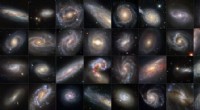
* The Milky Way is a spiral galaxy, meaning its disk has spiral arms that extend outward from the galactic center.
* Our solar system is currently located in a minor spiral arm called the Orion Arm.
* These arms are regions of higher density where star formation is more active.
* As our solar system orbits the galactic center, it travels through these arms.
4. Up and Down Motion:
* Our solar system doesn't just move in a flat plane. It also experiences a vertical oscillation, moving slightly up and down relative to the galactic disk.
* This motion is caused by the gravitational pull of the galaxy's disk and the galaxy's central bulge.
5. The Solar Neighborhood:
* Within the galactic disk, our solar system also moves relative to nearby stars.
* It's constantly interacting gravitationally with these stars, influencing its path slightly.
In summary, our solar system is engaged in a complex dance within the Milky Way galaxy. It orbits the galactic center, moves through its spiral arms, oscillates vertically, and interacts with its stellar neighbors. This grand motion is governed by the gravitational forces of the galaxy and its components.