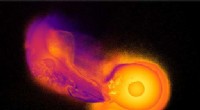
* The Sun's End: The Sun is a star. Stars have a finite lifespan determined by their mass and the rate at which they burn fuel. Our Sun will eventually run out of hydrogen fuel in its core, causing it to swell into a red giant, engulfing Mercury, Venus, and possibly Earth. It will then shed its outer layers, forming a planetary nebula, and leave behind a white dwarf, a dense, hot, and slowly cooling remnant of the Sun's core.
* The Universe's End: The universe's fate is still debated by cosmologists. Several scenarios are considered:
* Big Freeze: If the expansion of the universe continues forever, it will eventually become so cold and diffuse that all stars will burn out, leaving only a cold, dark expanse.
* Big Crunch: If the universe's expansion slows and reverses due to gravity, it could collapse back in on itself, ending in a fiery singularity, similar to the Big Bang in reverse.
* Big Rip: This scenario involves dark energy, a mysterious force driving the universe's expansion, becoming increasingly powerful. It could eventually tear apart galaxies, stars, planets, and even atoms themselves.
In summary:
* The Sun's death is a localized event that will happen in billions of years.
* The universe's end, however it occurs, is a much larger event spanning billions or even trillions of years, possibly involving the entire cosmos.
The Sun's end will have a direct impact on our solar system, while the universe's end is a much broader cosmological phenomenon.