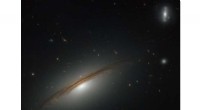
* Hubble sees objects based on their light**. The farther away an object is, the longer its light takes to reach us. So, when we look at distant objects with Hubble, we're essentially looking back in time.
* Hubble's "reach" is limited by the age of the universe**. Since the universe is about 13.8 billion years old, we can't see objects farther away than that because their light hasn't had time to reach us yet.
* The deepest image ever taken by Hubble** is the Hubble Ultra Deep Field (HUDF). It shows galaxies that existed about 13.4 billion years ago.
* Hubble has seen objects billions of light-years away, which is a vast distance. However, it's important to remember that these objects are not necessarily at that distance *now*. Since the universe is expanding, they might have moved even farther away since their light was emitted.
So, to summarize:
* Hubble doesn't have a fixed "range" like a radar.
* Its "reach" is limited by the age of the universe and the time light takes to travel.
* Hubble has observed objects billions of light-years away, but those objects might be even farther now.
Ultimately, Hubble's "seeing power" is defined by its ability to collect faint light from distant objects, allowing us to see further back in time and explore the universe's history.