Appearance:
* Invisible to the naked eye: Neutron stars are too small and faint to be seen directly with telescopes. Their appearance is based on the light they emit.
* Emitted radiation: Neutron stars emit radiation in various forms, including:
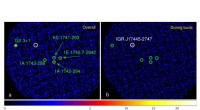
* X-rays: The most common way to detect neutron stars. They are powerful sources of X-rays due to their intense magnetic fields.
* Radio waves: Some neutron stars emit radio waves in pulses, giving them the name "pulsars."
* Gamma rays: Some neutron stars are powerful sources of gamma rays, particularly those with strong magnetic fields (magnetars).
* Optical light: Some neutron stars emit faint optical light, making them difficult to distinguish from other stars.
Unique Characteristics Contributing to Appearance:
* Strong magnetic fields: Neutron stars have the strongest magnetic fields in the universe, billions of times stronger than the Earth's magnetic field. These fields accelerate charged particles near the star, causing them to emit radiation.
* Rotation: Many neutron stars rotate incredibly fast, completing a rotation in just a few milliseconds. This rapid rotation can focus their radiation into beams that sweep across space, creating the pulsating effect observed in pulsars.
* Accretion disks: When a neutron star is in a binary system with a companion star, material from the companion can be pulled onto the neutron star, forming a swirling accretion disk. This material heats up and emits X-rays.
* Outbursts: Some neutron stars, particularly those with accretion disks, experience sudden bursts of energy, increasing their brightness significantly in X-rays and other wavelengths.
How these characteristics influence their appearance:
* Pulsars: The rapid rotation and strong magnetic fields of pulsars focus their radiation into beams that sweep across space like a lighthouse. We only see these beams when they point towards Earth, giving the impression of a pulsating source.
* X-ray binaries: Neutron stars in binary systems with accretion disks are powerful X-ray sources. The material in the accretion disk heats up and emits X-rays, making them easily detectable with X-ray telescopes.
* Magnetars: Neutron stars with extremely strong magnetic fields (magnetars) are powerful sources of gamma rays and can produce bursts of energy that can be detected across the universe.
Overall, neutron stars are fascinating objects that appear in a variety of ways, depending on their unique characteristics and their interactions with their surroundings. They are valuable tools for studying extreme physics and understanding the evolution of stars.