1. Initial Collapse:
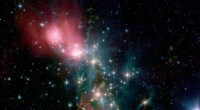
* Gravity's pull: Giant molecular clouds in space contain vast amounts of gas and dust. Gravity acts on these clouds, pulling the particles towards each other.
* Density increases: As particles get closer, the cloud's density increases, leading to more gravitational pull and a faster collapse.
2. Core Formation:
* Core formation: As the cloud collapses, it fragments into smaller clumps. These clumps continue to collapse under gravity, forming denser cores.
* Heating: The collapse causes the core to heat up due to collisions between particles. This heat leads to a pressure gradient within the core, pushing outwards.
3. Balancing Forces:
* Hydrostatic equilibrium: Eventually, the outward pressure due to heat and the inward pull of gravity reach an equilibrium. This creates a stable core.
4. Nuclear Fusion Ignition:
* Starbirth: If the core's temperature and pressure become high enough, nuclear fusion ignites. This is the point where the core becomes a star, releasing energy and halting further collapse.
In summary:
Gravity is the primary driving force behind star formation. It causes the initial collapse of gas and dust, leads to the formation of dense cores, and ultimately triggers the nuclear fusion that marks the birth of a star.