1. Atmospheric Distortion:
* Earth's atmosphere: Earth's atmosphere is a turbulent, ever-changing soup of gases that scatters and distorts light from celestial objects. This distortion, called "seeing," blurs images and limits the detail that can be observed from the ground.
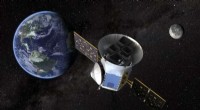
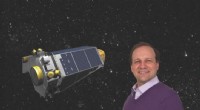
* Space telescopes: Orbiting above the atmosphere, space telescopes see a much clearer, sharper view of the cosmos, providing significantly higher resolution images.
2. Access to the Entire Electromagnetic Spectrum:
* Earth's atmosphere is opaque to many wavelengths: The atmosphere blocks most wavelengths of light, particularly infrared, ultraviolet, X-ray, and gamma rays.
* Space telescopes have unobstructed views: Space telescopes can observe these blocked wavelengths, giving astronomers a much more complete picture of celestial objects and processes.
3. Continuous Observation:
* Earth-based telescopes are limited by day and night: Earth-based telescopes can only observe objects when they are visible above the horizon, and weather conditions can further restrict observations.
* Space telescopes provide continuous observation: Space telescopes, orbiting above the Earth, can continuously observe objects without being affected by weather or day/night cycles.
4. Dark Skies and Less Interference:
* Light pollution: Earth-based telescopes are affected by light pollution from cities and towns, which can interfere with observations.
* Space telescopes are in pristine environments: Space telescopes operate in the near-perfect vacuum of space, far from light pollution and other sources of interference.
5. Technological Advancements:
* Space telescopes have become more advanced: Modern space telescopes are equipped with advanced instruments and technologies that are not possible to replicate on Earth, such as adaptive optics and interferometry.
However, it's not all sunshine and roses:
* Cost and risk: Launching and maintaining space telescopes is incredibly expensive and risky.
* Accessibility: While space telescopes provide unparalleled views, they are more difficult to access and use compared to ground-based telescopes.
In conclusion:
While ground-based telescopes still play an important role in astronomy, the advantages of orbiting telescopes, especially their ability to overcome atmospheric distortion and observe the full electromagnetic spectrum, have made them the preferred choice for many astronomical research projects.