1. Lunar Laser Ranging (LLR)
* This is the most accurate method currently available.
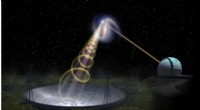
* It involves bouncing laser beams off retroreflectors (mirrors) placed on the Moon's surface by Apollo astronauts and Soviet robotic missions.
* By measuring the time it takes for the laser light to travel to the Moon and back, scientists can calculate the distance with astonishing precision – down to a few centimeters.
* This method provides a continuous and highly accurate measurement.
2. Parallax
* This method involves measuring the apparent shift in the Moon's position against the background of distant stars as viewed from two different locations on Earth.
* The greater the distance between the two observation points, the greater the parallax angle.
* By measuring the angle and knowing the distance between the observation points, scientists can calculate the distance to the Moon.
* This method is less accurate than LLR, but it was used extensively before the advent of lasers.
3. Kepler's Third Law
* This law relates the period of a celestial body's orbit around another body to the distance between them.
* By observing the Moon's orbital period around Earth and knowing the Earth's mass, scientists can estimate the distance to the Moon.
* This method is less precise than LLR or parallax, but it provides a reasonable estimate.
4. Earth-based Radar
* Similar to LLR but using radio waves instead of laser light.
* This method is less accurate than LLR but can be used for other celestial bodies like Venus and Mars.
Historically, other methods were used:
* Ancient Greek astronomers used geometric techniques based on observing the Moon's shadow during lunar eclipses.
* Early modern astronomers used triangulation techniques based on observing the Moon from different points on Earth.
It's important to note that the distance between Earth and the Moon is not constant due to the Moon's elliptical orbit. The average distance is about 384,400 km (238,855 miles), but it varies between approximately 363,104 km (225,623 miles) at perigee (closest point) and 405,696 km (252,088 miles) at apogee (farthest point).