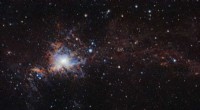
1. Gravitational Collapse:
* The nebula is mostly hydrogen and helium, with a small amount of heavier elements.
* Gravity pulls the particles within the nebula towards each other.
* As the particles get closer, they collide and heat up.
* This process creates a dense, hot core within the collapsing nebula.
2. Nuclear Fusion Ignition:
* The core becomes so hot and dense that the hydrogen atoms start to fuse together.
* This fusion reaction releases an immense amount of energy, primarily in the form of light and heat.
* This energy pushes outward against the inward pull of gravity, creating a balance.
3. Protostar Formation:
* The hot, glowing core is now a protostar, a young, developing star.
* It continues to gather more material from the surrounding nebula, growing in size and mass.
4. Main Sequence Stage:
* Eventually, the protostar becomes so hot and dense that the fusion reaction in its core becomes stable.
* The star enters the main sequence stage, the longest phase of its life.
* During this stage, the star's internal pressure and gravity are balanced, and it shines steadily.
What specifically marks the birth of a star?
There isn't a single, definitive moment that marks the birth of a star. It's more of a gradual process. However, the key event is the ignition of nuclear fusion in the core. This is the moment when the star becomes self-sustaining and begins to emit light and heat.
In summary:
* The birth of a star is a complex process that begins with the collapse of a nebula.
* The key event is the ignition of nuclear fusion in the core, which marks the beginning of a star's main sequence life.
* This fusion reaction releases immense energy, creating the light and heat we see in stars.
Let me know if you have any other questions!