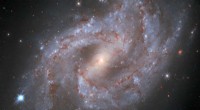
1. Giant Molecular Clouds (GMCs): These are vast, cold, and dense regions of space primarily composed of hydrogen and helium, along with trace amounts of heavier elements. They can span hundreds of light-years and contain enough material to form thousands of stars.
2. Gravitational Collapse: Within these GMCs, small, denser regions called cores can form. Over time, the gravitational pull of these cores becomes stronger than the internal pressure of the gas, causing the core to collapse.
3. Fragmentation: As the core collapses, it fragments into smaller, denser clumps. These clumps continue to collapse under their own gravity, further heating up and becoming increasingly dense.
4. Protostar Formation: As the collapsing clump becomes hot enough, the core ignites, forming a protostar. This is a very young star still surrounded by a disk of gas and dust.
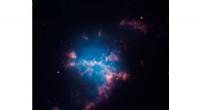
5. Nebula Formation: The remaining gas and dust that did not collapse into the protostar is still being heated and illuminated by the young star. This creates a glowing cloud around the protostar, which we see as a nebula.
Types of Nebulae:
* Emission Nebulae: These nebulae are heated by young, hot stars, causing them to emit their own light. They are often brightly colored, due to the emission lines of specific elements within them.
* Reflection Nebulae: These nebulae reflect the light of nearby stars, appearing blue due to the scattering of blue wavelengths.
* Dark Nebulae: These nebulae are dense and opaque, blocking the light from stars behind them. They appear as dark patches against the background of the Milky Way.
Ultimately, the formation of nebulae is directly tied to the birth of stars. The collapse of GMCs leads to the formation of both stars and the nebulae that surround them.