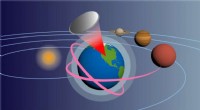
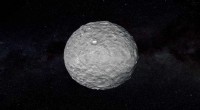
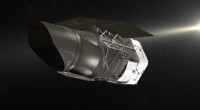
Within our Solar System:
* Planets: Probes have landed on Mars, Venus, and even Titan (a moon of Saturn), and have flown by all the planets in our solar system.
* Moons: We've sent probes to study the moons of Jupiter, Saturn, and even Pluto.
* Asteroids and Comets: Probes have been sent to study these celestial bodies up close, providing valuable information about the early solar system.
* The Sun: Probes like the Parker Solar Probe travel close to the Sun to study its activity.
Beyond our Solar System:
* Interstellar space: The Voyager 1 and 2 probes have left the heliosphere (the area of space dominated by the Sun's influence) and are now traveling through interstellar space.
* Exoplanets: Future missions are planned to study exoplanets, planets orbiting other stars.
The specific destination of a space probe depends on the mission's scientific goals. Some common objectives include:
* Mapping and studying the surface of celestial bodies.
* Analyzing the atmosphere and composition of planets and moons.
* Searching for signs of past or present life.
* Investigating the formation and evolution of the solar system.
* Understanding the nature of the Sun and its influence on Earth.
* Exploring the vastness of space and searching for new knowledge.
Fun fact: The furthest human-made object from Earth is Voyager 1, which is currently over 150 Astronomical Units (AU) away from Earth! (One AU is the average distance between the Earth and the Sun.)
So, to answer your question directly, space probes go wherever humanity's thirst for knowledge takes them!