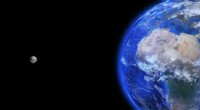
* The Moon's orbit is tilted: The Moon's orbital plane is tilted about 5.1 degrees relative to the ecliptic plane (the plane of Earth's orbit around the Sun). This tilt is responsible for the Moon's phases and eclipses.
* Gravitational influence of the Sun: While the Earth's gravity primarily governs the Moon's orbit, the Sun's gravity also plays a significant role. This influence tends to pull the Moon towards the ecliptic plane, slowly changing the Moon's orbital plane over time.
* Tidal forces: Tidal forces from the Sun and Earth also contribute to the Moon's orbital evolution. These forces act to slowly reduce the Moon's inclination, pulling it closer to the ecliptic plane.
So, why is the Moon still tilted at all?
* Initial conditions: The Moon's initial inclination likely resulted from its formation process.
* Balance of forces: The tilting forces from the Sun and Earth are balanced by the Moon's inertia. This means the Moon's orbital plane won't completely align with the ecliptic plane, but it will continue to oscillate around it over very long periods.
In summary: The Moon's orbit is not perfectly aligned with the ecliptic plane due to its initial tilt. However, the gravitational influence of the Sun and Earth continuously pulls the Moon towards the ecliptic plane, resulting in a gradual change in its orbital inclination over very long timescales.