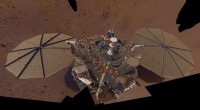
Mars, unlike Earth, has a thin, wispy atmosphere. Here's how it lost its once-thicker, more Earth-like atmosphere:
1. Solar Wind Stripping:
* The Process: The sun constantly emits a stream of charged particles known as the solar wind. This wind is powerful enough to strip away atmospheric gases from planets with weak magnetic fields.
* Mars's Weakness: Mars lacks a strong global magnetic field, unlike Earth. This leaves its atmosphere vulnerable to the solar wind's stripping effect.
* The Effect: Over billions of years, the solar wind has slowly eroded Mars's atmosphere, particularly the lighter gases like hydrogen and helium.
2. Atmospheric Escape:
* The Process: Even without the solar wind, some atmospheric gases can escape a planet's gravitational pull.
* Mars's Gravity: Mars is smaller than Earth, so its gravity is weaker. This makes it easier for atmospheric gases to reach escape velocity and leave the planet.
* The Effect: This process has gradually thinned Mars's atmosphere, contributing to its current thin state.
Why Mars Lost Its Atmosphere:
* Early Loss of Magnetic Field: It's believed Mars lost its magnetic field early in its history, perhaps due to its small size or internal cooling. This left it vulnerable to solar wind stripping.
* Lack of Plate Tectonics: Unlike Earth, Mars has limited geological activity and no plate tectonics. This limits its ability to replenish its atmosphere through volcanic outgassing.
* Weak Gravity: Its smaller size and weaker gravity have also played a significant role in atmospheric escape, making it easier for gases to escape into space.
Consequences of Atmosphere Loss:
* Uninhabitable Surface: The thin atmosphere can't effectively trap heat, leading to frigid temperatures and a harsh, uninhabitable surface.
* Liquid Water Loss: Without a thicker atmosphere, water on Mars is unable to exist in liquid form, evaporating quickly or freezing solid.
* Global Climate Change: The loss of atmospheric pressure and its greenhouse effect has significantly altered Mars's climate over time, leading to a cold, dry planet.
While the loss of its atmosphere is a major reason for Mars's current state, ongoing research is continually refining our understanding of this complex phenomenon.