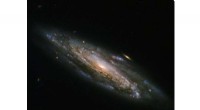
* Stars form continuously: The Milky Way is a dynamic galaxy, meaning it's constantly forming new stars from the gas and dust within its spiral arms. This process has been ongoing for billions of years.
* Star lifetimes vary: Stars have different lifespans depending on their mass. Smaller stars can live for tens of billions of years, while massive stars only live for a few million years.
* Stellar evolution: The chemical composition of stars changes over time. Early stars (Population III) were almost entirely made of hydrogen and helium. Later generations (Population II and I) contain heavier elements forged in the cores of older stars.
Here's how we categorize generations:
* Population III stars: These are hypothetical stars that formed from the very first material in the Universe. They are thought to have been massive and short-lived, and their remnants (black holes or neutron stars) may be contributing to the galaxy's evolution today.
* Population II stars: These are older stars with lower metallicity (meaning they contain fewer heavy elements). They are found in the halo of the Milky Way and in globular clusters.
* Population I stars: These are younger stars with higher metallicity. They are found in the disk of the Milky Way and are where our Sun belongs.
So, instead of a precise number, we can say that the Milky Way has a complex history of star formation, with multiple overlapping generations of stars existing within it.