Composition:
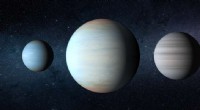
* Gaseous giants: All are primarily composed of hydrogen and helium, with traces of heavier elements like methane, ammonia, and water. They lack solid surfaces like the terrestrial planets.
* Low density: They are significantly less dense than the inner planets, with their atmospheres extending far into space.
Physical Characteristics:
* Large size and mass: All are significantly larger and more massive than Earth. Jupiter alone makes up over 70% of the mass of all the planets in our solar system.
* Fast rotation: They all rotate quickly on their axes, resulting in strong equatorial bulges and flattened polar regions.
* Ring systems: While Saturn is famous for its rings, all four outer planets have rings, though some are much fainter and less complex.
Atmospheric Features:
* Dynamic atmospheres: They have turbulent atmospheres with strong winds, storms, and complex cloud patterns.
* Cold temperatures: Their extreme distance from the Sun leads to very cold temperatures.
* Magnetic fields: All outer planets possess strong magnetic fields, much stronger than Earth's.
Moons:
* Numerous moons: They all have a large number of moons, some of which are surprisingly large and complex.
* Diverse moons: Their moons exhibit a variety of features and compositions, from icy worlds to geologically active bodies.
Other Similarities:
* Formation: They are believed to have formed in the outer, colder regions of the protoplanetary disk, where lighter elements were abundant.
* Orbit: They all orbit the Sun in a counter-clockwise direction.
Key Differences:
While they share similarities, the outer planets also have distinct differences in size, composition, atmospheric activity, and moon systems. For example, Uranus is tilted on its side, while Neptune has the strongest winds in our solar system.
These differences make each outer planet unique and fascinating to explore.