The Explosion:
* Core Collapse: The star's core, which is mostly iron, runs out of fuel and can no longer sustain fusion. The core collapses under its own gravity, generating incredible pressure and heat.
* Neutron Star Formation: The collapsing core compresses protons and electrons into neutrons, creating a super-dense object called a neutron star. These stars are only about 20 kilometers in diameter, but pack the mass of the Sun.
* Shockwave and Explosion: The collapse triggers a powerful shockwave that travels outward through the star, ripping it apart in a brilliant explosion. The energy released is equivalent to billions of suns combined, making it one of the most powerful events in the universe.
The Remnant:
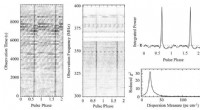
* Neutron Star: The core of the star survives the explosion, becoming a neutron star. These objects are incredibly dense, with a teaspoonful of neutron star material weighing billions of tons. They spin rapidly, emitting powerful radiation, and often have intense magnetic fields.
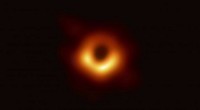
* Black Hole: If the star is massive enough (over 20-25 times the mass of the Sun), the core collapses beyond the neutron star stage, forming a black hole. Black holes have such strong gravity that nothing, not even light, can escape their pull.
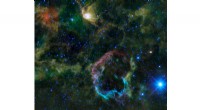
* Supernova Remnant: The material ejected from the star forms a vast cloud of gas and dust called a supernova remnant. These remnants expand outward at incredible speeds, sweeping up interstellar material and creating beautiful, complex structures that can be seen for thousands of years.
The Impact:
* Cosmic Recycling: Supernovae are incredibly important for the evolution of the universe. They distribute heavy elements like iron, oxygen, and carbon into space, which eventually go on to form new stars and planets.
* Triggering Star Formation: The shockwaves from supernovae can compress interstellar gas, triggering the formation of new stars.
* Cosmic Rays: Supernovae are a major source of cosmic rays, which are high-energy particles that travel throughout the galaxy.
Key takeaways:
* Supernovae of massive stars are incredibly powerful events that mark the end of a star's life.
* The remnants of these explosions include neutron stars and black holes, both fascinating and powerful objects.
* Supernovae are crucial for the evolution of the universe, distributing heavy elements and triggering the formation of new stars.