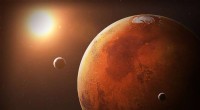
The solar system is comprised of a star (the Sun), planets, dwarf planets, moons, asteroids, comets, and interstellar dust and gas.
Here's a breakdown of the key components:
* The Sun: The Sun is a massive star composed primarily of hydrogen (70.6%) and helium (27.4%), with trace amounts of heavier elements. It provides the gravitational force that holds the solar system together and the energy that sustains life on Earth.
* Planets: The eight planets in our solar system can be broadly categorized into two groups:
* Inner Planets: Mercury, Venus, Earth, and Mars are rocky planets with solid surfaces. They are relatively small and dense compared to the outer planets.
* Outer Planets: Jupiter, Saturn, Uranus, and Neptune are gas giants, composed primarily of hydrogen and helium. They have much larger diameters and lower densities than the inner planets.
* Dwarf Planets: These are celestial objects similar to planets but lack dominance in their orbital region. Examples include Pluto, Eris, Ceres, and Makemake.
* Moons: Moons are natural satellites orbiting planets and dwarf planets. They vary greatly in size and composition, ranging from rocky bodies like our Moon to icy worlds like Jupiter's moon Europa.
* Asteroids: These are rocky or metallic bodies that orbit the Sun, primarily concentrated in the asteroid belt between Mars and Jupiter.
* Comets: Comets are icy bodies that orbit the Sun in highly eccentric paths. As they approach the Sun, they heat up, releasing gas and dust that form their characteristic tail.
* Interstellar Dust and Gas: This material fills the space between the celestial objects in our solar system and is constantly being replenished by collisions, eruptions from the Sun, and interstellar winds.
Scientists employ various methods to understand the structure of the solar system:
1. Observation:
* Telescopes: Powerful telescopes on Earth and in space provide detailed images and spectra of celestial objects, revealing their composition, size, and orbital parameters.
* Spacecraft: Space missions send probes to explore planets, moons, asteroids, and comets, providing close-up images and collecting data about their surfaces, atmospheres, and internal structures.
2. Mathematical Modeling:
* Gravitational Laws: Using Newton's and Einstein's laws of gravity, scientists can calculate the gravitational forces between celestial bodies and model their orbits.
* Computer Simulations: Complex simulations can recreate the evolution of the solar system over millions of years, helping us understand how it formed and how its structure changed.
3. Chemical Analysis:
* Spectral Analysis: By analyzing the light emitted or reflected by celestial objects, scientists can identify the elements and molecules present.
* Sample Analysis: Samples collected by spacecraft, like those from Mars and asteroids, are analyzed in laboratories to determine their composition and age, providing clues about the early solar system.
4. Geological Studies:
* Crater Analysis: The number and size of craters on planetary surfaces can reveal the age of the surface and the history of bombardment by asteroids and comets.
* Geomorphological Features: Features like volcanoes, canyons, and valleys provide insights into the geological processes that shaped the planets and moons.
These methods, used in combination, provide a comprehensive understanding of the solar system's structure, composition, and evolution. Scientists continue to explore and analyze these celestial bodies, constantly refining our knowledge and expanding our understanding of the universe.